-
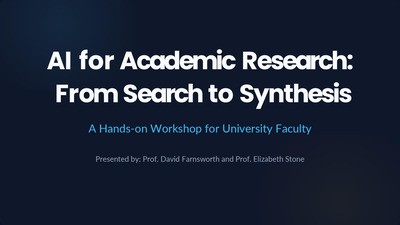
Using Research-focused LLMs
David Farnsworth and Elizabeth Stone
This hands-on workshop introduces university faculty to practical AI tools that support the full academic research workflow, from initial discovery to synthesis and writing. Participants explore the “Big 5” research tools—Perplexity.ai, Scite.ai, Elicit.com, ResearchRabbit, and SciSpace.com—along with Google’s Gemini extensions and NotebookLM, a source-grounded AI designed to analyze uploaded documents while maintaining privacy and providing live citations. The session demonstrates how these tools can accelerate literature reviews, fact-checking, visual mapping of citations, and deep synthesis of complex sources. Faculty also learn strategies for integrating AI responsibly into teaching, including helping students manage bibliographies, using AI for rubric-based feedback, and creating shared research workspaces for collaborative projects. The workshop emphasizes the ethical and effective use of AI to enhance, rather than replace, scholarly thinking and productivity.
-
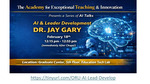
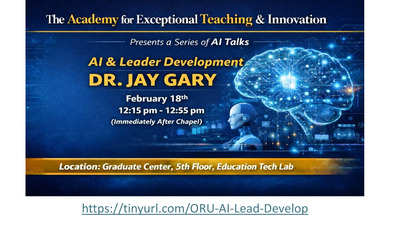
AI & Leader Development
Dr. Jay Gary
This presentation investigates the intersection of artificial intelligence and leader development, contrasting AI’s relentless daily learning and improvement with the imperative for intentional human growth. It explores how individuals can cultivate a strong “leader identity” through the power of tiny, consistent changes (atomic habits), daily micro-votes that reinforce desired identities across spirit, mind, and body, and the biblical practice of stacking virtues (2 Peter 1:5-8). The content integrates the nine-item Leader Identity Scale and guides participants to elevate their leader identity and effectiveness in an AI-driven era.
-
AI in Scholarship
Dr. Tim Hart
This presentation explores the appropriate role of artificial intelligence in scholarly work, distinguishing between uses that support academic rigor and those that undermine intellectual responsibility. While cautioning against reliance on AI for original argumentation, unverified literature reviews, data interpretation, and normative judgments, it highlights practical applications across the research lifecycle, including ideation, literature exploration, argument refinement, structural analysis, reviewer simulation, and manuscript preparation.
-
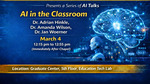
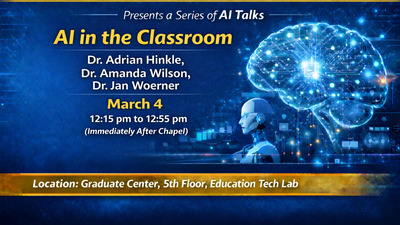
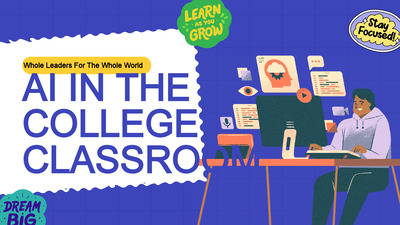
AI in the Classroom
Dr. Adrian E. Hinkle, Dr. Amanda Wilson, and Dr. Jan H. R. Wörner
This presentation examines how educators can thoughtfully integrate artificial intelligence into the classroom while upholding academic integrity, ethical engagement, and the core mission of education. It draws on historical parallels—from ancient concerns about writing to later fears surrounding typing—to frame AI as a double-edged sword that can offload routine cognitive tasks yet risks eroding the mental discipline and critical thinking essential for deep learning. Centered on the guiding question of what students truly need to learn and how technology can help them achieve it, the session offers practical assignment frameworks, such as designing an AI-supported ministry plan and developing a research prospectus that requires critical evaluation of AI output, to ensure students distinguish between tasks suitable for technological support and those that demand human judgment, pastoral presence, and spiritual formation. Ultimately, it equips educators to redesign pedagogy so that technology enhances rather than replaces the fundamental goal of training the mind to think.
-

AI Strategies for Effective Teaching & Learning
Dr. Jared Johnston and Prof. Adrian Caraballo
This presentation discusses strategies for effectively integrating artificial intelligence into college classrooms, with a focus on developing AI literacy among students and faculty. Core principles highlight AI as a tool for augmentation rather than replacement, with faculty maintaining oversight while supporting learner preparation, clinical reasoning, and reflective practice. The session stresses the need to rethink course and activity design in the AI era, training students to strategically offload tasks without cognitively offloading thinking. Practical guidance includes questions for intentional integration, experiential learning approaches, and real-world classroom examples from operational leadership courses in which students apply AI within authentic educational leadership contexts while upholding academic integrity and ethical standards.
-
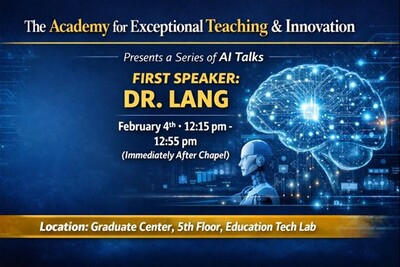
AI and Abolition of the Student
Dr. Andrew Lang
This presentation examines how advances in technology—from writing and calculators to artificial intelligence—have transformed the way humans think and learn. Focusing on the concept of cognitive offloading, the speaker highlights how external tools support thinking while also introducing the risk of deskilling when foundational abilities are not fully developed.
Special attention is given to the rise of AI and generative technologies, which extend beyond supporting cognition to enabling what the speaker terms “agency offloading”—delegating not only knowledge retrieval but also aspects of thinking and decision-making. This shift raises important questions about student learning, independent thought, and the future of education.
Drawing on the historical example of calculators in mathematics, the talk argues that current educational models—especially those based on evaluating final outputs, such as essays—are no longer sufficient. Instead, it calls for a transformation in assessment practices toward evaluating process, reasoning, and intellectual formation.
The session concludes by emphasizing the need to balance AI literacy with the broader goal of developing critical thinking and whole-person education, ensuring that learners are prepared not only for the workplace but for meaningful engagement in an AI-driven world.
Printing is not supported at the primary Gallery Thumbnail page. Please first navigate to a specific Image before printing.